Hemoglobin Levels: Normal Ranges by Age and Sex
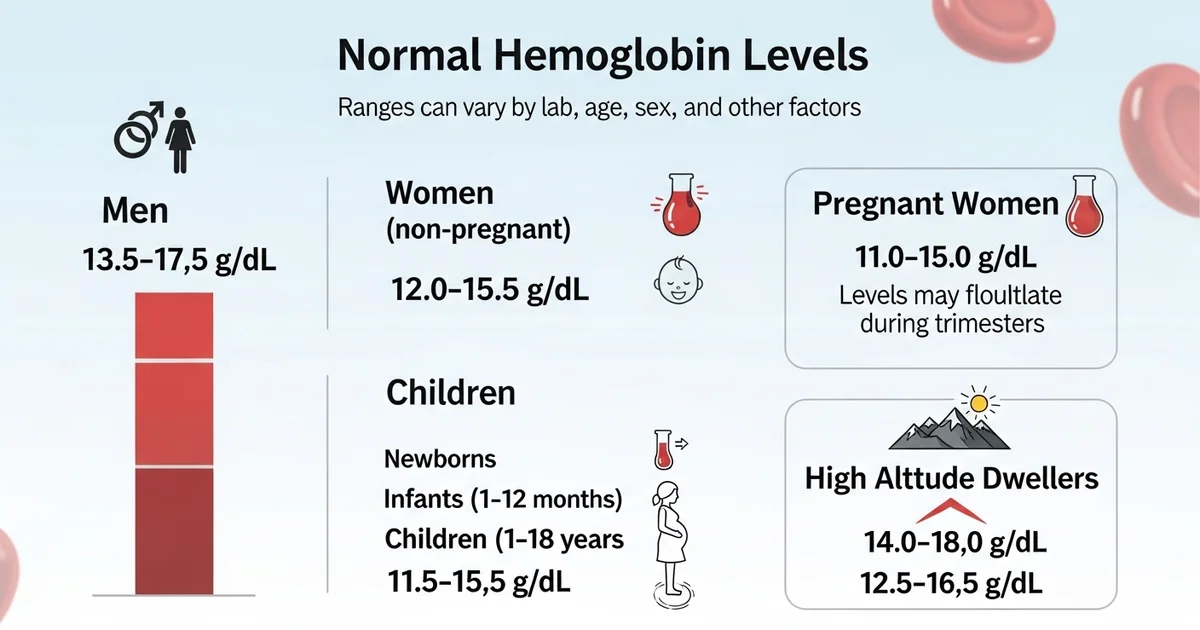
Direct answer: Normal hemoglobin (Hb) levels vary by age and sex. For adults, the typical range is 13.5-17.5 g/dL for men and 12.0-15.5 g/dL for women. These values change for children and during pregnancy. Low hemoglobin may indicate anemia, while high levels can suggest dehydration or other medical conditions.
TL;DR Hemoglobin is the protein in red blood cells that carries oxygen from your lungs to the rest of your body. Your hemoglobin level is a key part of a complete blood count (CBC) test, and what's considered "normal" depends on your age, sex, and other factors like pregnancy or altitude. Abnormal levels can be the first sign of a medical issue, so understanding the ranges is important for interpreting your blood test results.
- Adult Men: Typically have higher levels, around 13.5 to 17.5 grams per deciliter (g/dL).
- Adult Women: Normal range is slightly lower, from 12.0 to 15.5 g/dL, partly due to menstrual blood loss.
- Pregnancy: Levels often decrease due to increased blood volume, with ranges dropping to around 10.5 g/dL.
- Infants & Children: Values are very high at birth, drop during infancy, and then gradually rise to adult levels.
- Low Hemoglobin (Anemia): Can cause fatigue, weakness, and shortness of breath. It's often linked to iron or vitamin deficiencies, chronic disease, or blood loss.
- High Hemoglobin (Polycythemia): Can be caused by dehydration, smoking, living at high altitude, or certain bone marrow disorders. It may increase the risk of blood clots.
Want the full explanation? Keep reading ↓
Hemoglobin (Hb) is a critical protein found in red blood cells that plays an indispensable role in maintaining life. Its primary function is to transport oxygen from the lungs to the body's tissues and carry carbon dioxide back to the lungs to be exhaled. Understanding the normal range of hemoglobin is crucial for assessing overall health, diagnosing various medical conditions, and monitoring treatment effectiveness. However, what constitutes a "normal" hemoglobin level is not a single, fixed number; it varies significantly based on factors such as age, sex, and even specific physiological states like pregnancy.
This article will delve into the intricacies of hemoglobin reference ranges, exploring how they differ across various populations and what these variations signify for your health.
What is Hemoglobin?
To fully appreciate these ranges, it's essential to understand [what hemoglobin is and its vital function in red blood cells]. Hemoglobin is a complex metalloprotein containing iron, which gives blood its characteristic red color. Each hemoglobin molecule is composed of four protein chains (globins), each bound to a heme group. It's the iron atom within the heme group that reversibly binds to oxygen, facilitating its transport throughout the bloodstream. Without adequate hemoglobin, the body's tissues and organs would be deprived of the oxygen they need to function, leading to a cascade of health problems.
Why Hemoglobin Levels Matter
Hemoglobin levels are a key component of a complete blood count (CBC), one of the most common blood tests performed. Abnormal hemoglobin levels can be an early indicator of a wide range of medical conditions, some mild and easily treatable, others more serious and requiring urgent intervention.
- Low Hemoglobin: Often indicative of anemia, a condition where the blood lacks healthy red blood cells or sufficient hemoglobin. This impairs oxygen delivery, leading to symptoms like fatigue, weakness, shortness of breath, and pale skin.
- High Hemoglobin: Known as polycythemia, this can occur when the body produces too many red blood cells or when blood plasma volume decreases (e.g., due to dehydration). High levels can thicken the blood, increasing the risk of blood clots, heart attack, and stroke.
Monitoring hemoglobin levels allows healthcare providers to identify potential health issues, guide diagnostic investigations, and tailor treatment plans to optimize patient outcomes.
Factors Influencing Hemoglobin Levels
Several physiological and external factors can influence an individual's hemoglobin concentration:
- Age: Hemoglobin levels change dramatically from birth through childhood and into adulthood, with different ranges for infants, children, and adults.
- Sex: Adult men typically have higher hemoglobin levels than adult women, primarily due to hormonal differences and menstrual blood loss in premenopausal women.
- Pregnancy: Pregnant women often experience a physiological decrease in hemoglobin due to an increase in plasma volume (hemodilution).
- Altitude: People living at higher altitudes naturally have higher hemoglobin levels to compensate for the lower oxygen concentration in the air.
- Smoking: Smokers often have slightly higher hemoglobin levels due to chronic carbon monoxide exposure, which reduces oxygen-carrying capacity, prompting the body to produce more red blood cells.
- Hydration Status: Dehydration can temporarily elevate hemoglobin levels by reducing plasma volume, making the blood more concentrated.
- Medical Conditions: Various diseases, including kidney disease, chronic inflammatory conditions, certain cancers, and bone marrow disorders, can significantly impact hemoglobin production or destruction.
Understanding Hemoglobin Reference Ranges
It's crucial to understand that "normal ranges" are statistical averages derived from a healthy population. They are not absolute thresholds, and minor deviations may not always indicate a problem. Furthermore, reference ranges can vary slightly between different laboratories due to variations in equipment, testing methodologies, and the specific population from which their ranges were established. For this reason, always refer to the specific reference range provided by the laboratory that performed your test. Your healthcare provider will interpret your results in the context of your overall health, medical history, and any symptoms you may be experiencing.
Hemoglobin Normal Range by Age and Sex
The following table provides general reference ranges for hemoglobin. These values are typically expressed in grams per deciliter (g/dL), though some laboratories may use millimoles per liter (mmol/L).
| Population | Normal Range (g/dL) | Units | Notes |
|---|---|---|---|
| Newborns (1-3 days) | 14.0 - 24.0 | g/dL | Higher at birth, gradually decreases |
| Infants (1-3 months) | 10.0 - 14.0 | g/dL | Lowest point around 2-3 months |
| Children (1-6 years) | 11.5 - 13.5 | g/dL | Gradually increases with age |
| Children (7-12 years) | 11.5 - 15.5 | g/dL | Approaches adult levels |
| Adult Men | 13.5 - 17.5 | g/dL | Generally higher than adult women |
| Adult Women (non-pregnant) | 12.0 - 15.5 | g/dL | Affected by menstruation |
| Pregnant Women (1st trimester) | 11.0 - 15.0 | g/dL | Physiological hemodilution begins |
| Pregnant Women (2nd trimester) | 10.5 - 14.0 | g/dL | Lowest point during pregnancy |
| Pregnant Women (3rd trimester) | 10.5 - 14.0 | g/dL | Levels stabilize or slightly rise |
Important Note: These ranges are general guidelines. Always consult your specific laboratory's reference range and discuss your results with your healthcare provider.
Detailed Breakdown of Ranges
Let's explore the nuances of hemoglobin levels across different age groups and sexes in more detail.
Infants and Children
Hemoglobin levels undergo significant changes during the first few years of life:
- Newborns: At birth, infants have remarkably high hemoglobin levels (14.0-24.0 g/dL). This is because they are accustomed to a relatively low-oxygen environment in the womb, and their bodies produce more red blood cells to compensate. Fetal hemoglobin (HbF) is also predominant at this stage, which has a higher affinity for oxygen.
- Infants (2-3 Months): After birth, as infants are exposed to a higher oxygen environment, the body naturally reduces red blood cell production, and fetal hemoglobin is replaced by adult hemoglobin (HbA). This physiological adjustment leads to a temporary drop in hemoglobin levels, often reaching their lowest point around 2-3 months of age (around 10.0-14.0 g/dL), a phenomenon sometimes called "physiologic anemia of infancy."
- Older Children: As children grow, their hemoglobin levels gradually increase, stabilizing closer to adult ranges by puberty. Nutritional status, particularly iron intake, is a critical factor influencing hemoglobin levels throughout childhood. Iron deficiency is a common cause of anemia in this age group.
Adult Men
Adult men typically have the highest hemoglobin reference range, generally between 13.5 and 17.5 g/dL. This is primarily attributed to:
- Androgens: Male hormones, particularly testosterone, stimulate erythropoiesis (red blood cell production) in the bone marrow.
- Absence of Menstrual Blood Loss: Unlike premenopausal women, men do not experience regular blood loss through menstruation, which can deplete iron stores.
Adult Women (Non-Pregnant)
The normal hemoglobin range for adult non-pregnant women is generally 12.0 to 15.5 g/dL, which is slightly lower than that for men. Key factors contributing to this difference include:
- Menstruation: Regular monthly blood loss during menstruation can lead to a gradual depletion of iron stores, making women more susceptible to iron deficiency anemia.
- Estrogen: While not as potent a stimulant for erythropoiesis as testosterone, estrogen levels can also play a role in blood cell regulation.
- Post-Menopausal Women: After menopause, when menstruation ceases, women's hemoglobin levels tend to rise and may approach those of adult men, provided there are no other underlying conditions causing anemia.
Pregnant Women
Pregnancy introduces unique physiological changes that affect hemoglobin levels:
- Hemodilution: During pregnancy, a woman's blood volume significantly increases (by 40-50%) to support the growing fetus and placenta. While the production of red blood cells also increases, the plasma volume (the fluid component of blood) increases at a faster rate. This disproportionate increase leads to a dilution effect, resulting in a physiological decrease in hemoglobin concentration.
- Iron Demand: The growing fetus requires a substantial amount of iron for its own red blood cell production, further increasing the mother's iron requirements.
- Recommended Ranges:
- First Trimester: 11.0-15.0 g/dL
- Second Trimester: 10.5-14.0 g/dL (often the lowest point)
- Third Trimester: 10.5-14.0 g/dL (levels may stabilize or slightly rise)
Due to these factors, iron supplementation is routinely recommended for pregnant women to prevent or treat iron deficiency anemia, which can have adverse effects on both mother and baby.
What Do Abnormal Hemoglobin Levels Mean?
Understanding the normal ranges is only half the battle; interpreting deviations is where clinical significance lies.
Low Hemoglobin (Anemia)
Anemia is a condition characterized by a reduced number of red blood cells or a reduced amount of hemoglobin in the blood, leading to impaired oxygen transport. It is a common condition with numerous causes:
- Iron Deficiency Anemia: The most common type, resulting from insufficient iron to produce hemoglobin. Causes include inadequate dietary iron intake, chronic blood loss (e.g., heavy menstruation, gastrointestinal bleeding), and malabsorption.
- Vitamin Deficiency Anemia: Lack of vitamin B12 or folate, which are essential for red blood cell production, can lead to megaloblastic anemia.
- Anemia of Chronic Disease: Often seen in individuals with chronic inflammatory conditions (e.g., rheumatoid arthritis, Crohn's disease), kidney disease, or cancer. The body's inflammatory response interferes with iron utilization and red blood cell production.
- Aplastic Anemia: A rare but serious condition where the bone marrow fails to produce enough blood cells, including red blood cells.
- Hemolytic Anemia: Occurs when red blood cells are destroyed faster than they can be produced. Causes include autoimmune disorders, certain infections, and inherited conditions like sickle cell anemia or thalassemia.
- Blood Loss: Acute (e.g., trauma, surgery) or chronic (e.g., ulcers, hemorrhoids) blood loss can directly reduce hemoglobin levels.
Symptoms of Anemia: Fatigue, weakness, pale skin, shortness of breath, dizziness, cold hands and feet, headaches, and brittle nails.
High Hemoglobin (Polycythemia)
Elevated hemoglobin levels, or polycythemia, can also be a cause for concern:
- Dehydration: As mentioned, a temporary increase in hemoglobin can occur when plasma volume decreases, making the blood more concentrated. This is often easily corrected by rehydration.
- Living at High Altitudes: The body naturally produces more red blood cells to compensate for lower oxygen levels in the air.
- Chronic Lung Diseases: Conditions like chronic obstructive pulmonary disease (COPD) or pulmonary fibrosis can lead to chronically low blood oxygen levels, stimulating increased red blood cell production.
- Smoking: Chronic exposure to carbon monoxide from smoking can lead to higher hemoglobin levels as the body tries to compensate for the reduced oxygen-carrying capacity of the blood.
- Polycythemia Vera: A rare bone marrow disorder where the bone marrow produces too many red blood cells, as well as sometimes too many white blood cells and platelets. This is a serious condition that increases the risk of blood clots.
- Kidney Tumors: Some kidney tumors can produce erythropoietin, a hormone that stimulates red blood cell production.
Symptoms of Polycythemia: Headache, dizziness, fatigue, shortness of breath, blurred vision, redness of the skin, itching (especially after a warm bath), and numbness or tingling in the hands and feet.
When to Seek Medical Advice
If your hemoglobin test results fall outside the normal range, it's essential to consult with your healthcare provider. They will consider your symptoms, medical history, other blood test results (such as red blood cell count, hematocrit, and mean corpuscular volume), and conduct a physical examination to determine the underlying cause. Self-diagnosing or self-treating based solely on a single lab value is not recommended.
Actionable Advice for Maintaining Healthy Hemoglobin Levels
While specific medical conditions require targeted treatments, some general lifestyle and dietary strategies can support healthy hemoglobin levels:
- Balanced Diet:
- Iron-rich foods: Include lean red meat, poultry, fish, beans, lentils, spinach, fortified cereals, and tofu.
- Vitamin C: Consume foods high in vitamin C (citrus fruits, bell peppers, broccoli) as it enhances iron absorption.
- Folate-rich foods: Leafy green vegetables, fruits, nuts, beans, and fortified grains.
- Vitamin B12-rich foods: Meat, fish, dairy products, and fortified plant-based milks.
- Stay Hydrated: Drink plenty of water throughout the day to maintain proper blood volume and prevent temporary elevations in hemoglobin due to dehydration.
- Avoid Smoking: Quitting smoking can significantly improve overall health, including oxygen-carrying capacity and hemoglobin regulation.
- Manage Underlying Conditions: Work with your doctor to effectively manage any chronic diseases that might affect red blood cell production or destruction.
- Regular Check-ups: Routine physical examinations and blood tests can help monitor your hemoglobin levels and detect any abnormalities early.
Conclusion
Hemoglobin is a vital component of our blood, essential for oxygen transport and overall health. Its normal range is not static but dynamically influenced by age, sex, and various physiological states. Understanding these variations and the potential implications of abnormal levels empowers individuals to be more informed participants in their healthcare journey. Always remember that laboratory results should be interpreted by a qualified healthcare professional who can provide personalized advice and guidance based on your unique health profile.
Frequently Asked Questions
What is the most common cause of abnormal Hemoglobin (Hb) levels?
The most common cause of abnormally low Hemoglobin (Hb) levels is iron deficiency anemia. This occurs when the body does not have enough iron to produce sufficient hemoglobin, often due to inadequate dietary intake, chronic blood loss (such as heavy menstrual periods or gastrointestinal bleeding), or impaired iron absorption. For high Hemoglobin levels, dehydration is a very common temporary cause, as it concentrates the blood. However, chronic high levels often point to conditions like chronic lung disease or, less commonly, bone marrow disorders such as polycythemia vera.
How often should I get my Hemoglobin (Hb) tested?
The frequency of Hemoglobin (Hb) testing depends on your age, health status, and any existing medical conditions.
- Routine Check-ups: For healthy adults, a hemoglobin test is usually part of a complete blood count (CBC) performed during annual physical exams or every few years, as recommended by your doctor.
- Specific Risk Factors: If you have risk factors for anemia (e.g., heavy menstruation, vegetarian/vegan diet, chronic illness, pregnancy), your doctor may recommend more frequent testing.
- Monitoring Conditions: Individuals with diagnosed anemia, chronic kidney disease, or other conditions affecting blood production will require regular monitoring as advised by their healthcare provider.
- Symptoms: If you experience symptoms like persistent fatigue, shortness of breath, dizziness, or pale skin, you should consult your doctor, who will likely order a hemoglobin test.
Can lifestyle changes improve my Hemoglobin (Hb) levels?
Yes, for certain types of abnormal hemoglobin levels, lifestyle changes can significantly help improve and maintain healthy levels:
- For Low Hemoglobin (Anemia):
- Dietary Iron Intake: Increase consumption of iron-rich foods (red meat, poultry, fish, beans, lentils, spinach, fortified cereals).
- Vitamin C Intake: Pair iron-rich foods with vitamin C sources (citrus fruits, bell peppers, broccoli) to enhance iron absorption.
- Folate and B12: Ensure adequate intake of foods rich in folate (leafy greens, nuts, beans) and vitamin B12 (meat, dairy, fortified foods).
- Avoid Iron Absorption Inhibitors: Limit consumption of coffee, tea, and calcium-rich foods or supplements around iron-rich meals, as they can inhibit iron absorption.
- For High Hemoglobin (Polycythemia) (if not due to serious underlying disease):
- Hydration: Drink plenty of water throughout the day to prevent dehydration, which can temporarily increase hemoglobin levels.
- Quit Smoking: If you smoke, quitting can help reduce chronically elevated hemoglobin levels.
- Limit Alcohol: Excessive alcohol can sometimes contribute to dehydration. However, it's crucial to consult your doctor to understand the underlying cause of your abnormal hemoglobin levels. Lifestyle changes are most effective when addressing nutritional deficiencies or dehydration but may not be sufficient for more serious medical conditions, which require specific medical treatment.
Medical Disclaimer
This article is for educational purposes only. Always consult a healthcare professional.