Hematocrit (Hct): What It Means in Your Blood Test
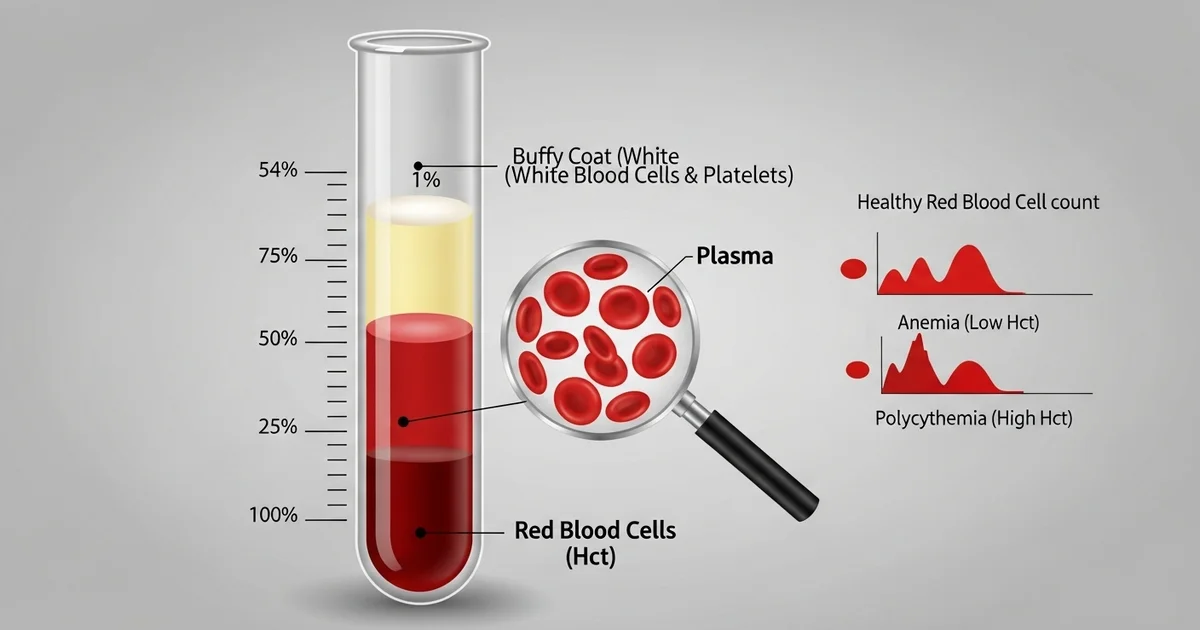
Direct answer: Hematocrit (Hct) is the percentage of your blood volume made up of red blood cells. It's a key part of a complete blood count (CBC) used to check for conditions like anemia (low hematocrit) or polycythemia (high hematocrit), and can also reflect your body's hydration status.
TL;DR Hematocrit (Hct) measures the proportion of red blood cells in your blood, which is essential for understanding your body's ability to carry oxygen. A low hematocrit level typically indicates anemia, which can be caused by blood loss, nutritional deficiencies, or chronic disease. A high hematocrit level can be a sign of dehydration or a more serious condition called polycythemia, where your body produces too many red blood cells. Your doctor will interpret your Hct level along with other blood test results, like hemoglobin, to get a complete picture of your health.
- Hematocrit is the percentage of red blood cells by volume in your blood.
- Low hematocrit is a primary indicator of anemia, leading to symptoms like fatigue and weakness.
- High hematocrit can be caused by dehydration or by conditions that increase red blood cell production.
- Normal ranges vary by age, sex, and pregnancy status, but are generally 40-54% for men and 36-48% for women.
- Hematocrit is often compared to hemoglobin in a 3:1 ratio; deviations can signal issues with red blood cell size or shape.
- Always discuss abnormal results with a healthcare provider for proper diagnosis and treatment.
Want the full explanation? Keep reading ↓
The complete blood count (CBC) is a fundamental diagnostic tool in medicine, offering a comprehensive snapshot of a patient's blood components. Among the myriad parameters it measures, hematocrit (Hct) and hemoglobin (Hb) stand out as crucial indicators of red blood cell health and, by extension, the body's oxygen-carrying capacity. While often discussed together and intrinsically linked, understanding their individual roles and the relationship between them is key to accurate clinical interpretation. This article delves into the definitions of hematocrit and hemoglobin, explores their interconnectedness, and explains the clinical significance of their ratio.
What is Hemoglobin (Hb)?
Hemoglobin (Hb) is a complex protein found within red blood cells, primarily responsible for transporting oxygen from the lungs to the body's tissues and carbon dioxide from the tissues back to the lungs. It is an iron-rich protein that gives blood its characteristic red color.
Structure and Function of Hemoglobin
- Structure: Hemoglobin is composed of four protein chains (globins), each associated with a heme group. At the center of each heme group is an iron atom, which is the binding site for oxygen.
- Oxygen Transport: The primary function of hemoglobin is to bind reversibly with oxygen. In the lungs, where oxygen concentration is high, hemoglobin picks up oxygen. In the tissues, where oxygen concentration is low, it releases oxygen.
- Carbon Dioxide Transport: Hemoglobin also plays a role in transporting carbon dioxide, though to a lesser extent than oxygen. It binds to carbon dioxide at a different site than oxygen, facilitating its removal from the body.
- Buffering Capacity: Hemoglobin contributes to the blood's buffering system, helping to maintain a stable pH.
Hemoglobin levels are typically measured in grams per deciliter (g/dL) of blood. Abnormal hemoglobin levels can indicate a variety of conditions, from anemia (low levels) to polycythemia (high levels), impacting the body's ability to oxygenate tissues effectively.
What is Hematocrit (Hct)?
Hematocrit (Hct), also known as packed cell volume (PCV), represents the percentage of red blood cells in a given volume of whole blood. It is a direct measure of the proportion of blood that is composed of red blood cells. To learn more about how this vital parameter is assessed, you can explore what the [hematocrit test is defined as and what it measures].
How Hematocrit is Measured
Traditionally, hematocrit was determined by centrifuging a blood sample in a capillary tube. The heavier red blood cells settle at the bottom, separating from the lighter plasma and a thin layer of white blood cells and platelets (buffy coat). The height of the red blood cell column is then measured and expressed as a percentage of the total blood volume. Modern automated hematology analyzers calculate hematocrit indirectly from red blood cell count and mean corpuscular volume (MCV).
Clinical Significance of Hematocrit
- Oxygen-Carrying Capacity: A higher hematocrit generally means more red blood cells are available to carry oxygen, while a lower hematocrit indicates fewer red blood cells, potentially leading to reduced oxygen delivery to tissues.
- Hydration Status: Hematocrit can be influenced by a person's hydration status. Dehydration can cause a falsely elevated hematocrit (hemoconcentration) because the plasma volume decreases, making the red blood cells appear more concentrated. Conversely, overhydration can cause a falsely lowered hematocrit (hemodilution).
- Indicator of Anemia or Polycythemia: Like hemoglobin, hematocrit is a primary indicator for diagnosing anemia (low Hct) or polycythemia (high Hct). Understanding [normal hematocrit levels, charts, and interpretation] is crucial for identifying these conditions.
The Interconnectedness: Hematocrit and Hemoglobin
Hemoglobin and hematocrit are inextricably linked because hemoglobin is contained within red blood cells, and hematocrit measures the volume of these red blood cells. Therefore, changes in one typically reflect changes in the other.
The Hct:Hb Ratio
In healthy individuals with normal red blood cell size and hemoglobin content, there is a fairly consistent relationship between hematocrit and hemoglobin. This relationship is often expressed as a ratio, where the hematocrit value is approximately three times the hemoglobin value when hemoglobin is measured in g/dL and hematocrit in percentage.
For example:
- If hemoglobin is 15 g/dL, then hematocrit would typically be around 45%.
- If hemoglobin is 12 g/dL, then hematocrit would typically be around 36%.
This "rule of three" is a useful quick check for laboratory professionals and clinicians to ensure the consistency of CBC results.
Clinical Significance of Understanding the Ratio
While Hct and Hb usually move in parallel, deviations from the expected 3:1 ratio can provide valuable diagnostic clues.
When the Ratio is Maintained
When both hemoglobin and hematocrit are low, but their ratio remains around 3:1, it strongly suggests anemia. This indicates a reduced overall mass of red blood cells and/or a reduced concentration of hemoglobin within those cells. Further investigation, such as examining red blood cell indices (MCV, MCH, MCHC), would be needed to determine the specific type of anemia (e.g., iron deficiency anemia, vitamin B12 deficiency anemia).
Similarly, when both are high and maintain the ratio, it suggests polycythemia, an increase in the number of red blood cells. This can be primary (e.g., polycythemia vera) or secondary (e.g., due to chronic hypoxia, high altitude, or certain kidney diseases). For a deeper understanding of this condition, you can read about [high hematocrit causes and health implications].
When the Ratio is Disproportionate
Deviations from the typical 3:1 ratio can signal specific underlying issues:
- High Hemoglobin-to-Hematocrit Ratio (e.g., Hct < 3 x Hb): This might suggest that the red blood cells, though fewer in number or volume (lower Hct), are packed with more hemoglobin than usual, or that the red blood cells are smaller than normal (microcytic). It could also indicate issues with red blood cell hydration, where red blood cells are relatively dehydrated, leading to a smaller volume (lower Hct) despite adequate Hb content. This is less common but can be seen in certain conditions affecting red blood cell water balance.
- Low Hemoglobin-to-Hematocrit Ratio (e.g., Hct > 3 x Hb): This scenario implies that the red blood cells are larger than normal (macrocytic) but may be relatively deficient in hemoglobin (hypochromic), or that there is an issue with red blood cell swelling. For example, in conditions like spherocytosis or certain types of hemolytic anemia, red blood cells can be swollen or have an abnormal shape, leading to a higher measured hematocrit for a given hemoglobin level. It can also be seen in cases of hemolysis where hemoglobin might be released from red blood cells into the plasma but still contribute to the overall Hb measurement, while the Hct reflects only the intact red blood cells.
Key takeaway: The Hct:Hb ratio serves as an internal quality control check and a diagnostic clue. A consistent ratio points towards conditions affecting the overall quantity of red blood cells or their hemoglobin content proportionally. A skewed ratio prompts investigation into issues affecting red blood cell size, shape, or hemoglobin concentration within the individual cells, or issues with hydration status.
Normal Reference Ranges for Hematocrit and Hemoglobin
It's important to remember that reference ranges can vary slightly between laboratories due to different testing methodologies and populations. Always refer to the specific ranges provided by the laboratory performing the test.
| Population | Normal Range (Hct) | Units (Hct) | Normal Range (Hb) | Units (Hb) | Notes |
|---|---|---|---|---|---|
| Adult Men | 40-54 | % | 13.5-17.5 | g/dL | Higher due to testosterone and muscle mass |
| Adult Women (Non-pregnant) | 36-48 | % | 12.0-15.5 | g/dL | Lower due to menstrual blood loss |
| Pregnant Women | 30-45 | % | 11.0-14.0 | g/dL | Physiological hemodilution, especially in 2nd/3rd trimesters |
| Children (Age-dependent) | 30-44 | % | 10.0-14.0 | g/dL | Ranges vary significantly with age, higher at birth, then lower |
Note: These ranges are general guidelines. Individual results should always be interpreted by a healthcare professional in the context of a patient's overall health, medical history, and other diagnostic findings.
Factors Affecting Hematocrit and Hemoglobin Levels
Numerous physiological and pathological factors can influence Hct and Hb levels.
Causes of Low Hct and Hb (Anemia)
- Iron Deficiency: The most common cause of anemia worldwide, leading to microcytic, hypochromic red blood cells.
- Vitamin Deficiencies: Lack of Vitamin B12 or folate, crucial for red blood cell production, resulting in macrocytic anemia.
- Chronic Diseases: Kidney disease, chronic inflammatory conditions, and cancer can suppress red blood cell production.
- Blood Loss: Acute (e.g., trauma, surgery) or chronic (e.g., gastrointestinal bleeding, heavy menstruation).
- Hemolysis: Premature destruction of red blood cells due to various causes (e.g., autoimmune conditions, genetic disorders).
- Bone Marrow Disorders: Conditions affecting the bone marrow's ability to produce blood cells (e.g., aplastic anemia, leukemia).
- Overhydration: Dilution of blood components can lead to relatively lower Hct and Hb values.
Causes of High Hct and Hb (Polycythemia)
- Dehydration: The most common cause of a relative increase, as plasma volume decreases, concentrating red blood cells.
- Chronic Hypoxia: The body produces more red blood cells to compensate for low oxygen levels (e.g., living at high altitudes, chronic obstructive pulmonary disease, sleep apnea, severe heart disease).
- Polycythemia Vera: A rare bone marrow disorder where the body produces too many red blood cells independently.
- Kidney Disease: Rarely, certain kidney tumors can produce erythropoietin, a hormone that stimulates red blood cell production.
- Smoking: Chronic smoking can lead to higher carboxyhemoglobin levels, impairing oxygen delivery and stimulating erythropoietin production.
Interpreting Your Results and When to Seek Medical Advice
Understanding the difference between hematocrit and hemoglobin, and the significance of their ratio, empowers you to have a more informed discussion with your healthcare provider.
If your Hct and Hb levels are within the normal range, it generally indicates healthy red blood cell production and oxygen-carrying capacity.
If your levels are outside the normal range, your doctor will consider these results in the context of your overall health, symptoms, and other diagnostic tests.
- Low levels (anemia) may require further investigation to determine the underlying cause and appropriate treatment, which could range from dietary changes and supplements to medication or management of chronic diseases.
- High levels (polycythemia) also warrant further investigation. While dehydration is a common and easily reversible cause, persistent high levels could indicate more serious underlying conditions requiring medical intervention.
It is crucial to never self-diagnose or attempt to treat abnormal blood test results without professional medical guidance. Your doctor will use these results as part of a comprehensive assessment to develop the best course of action for your health.
Conclusion
Hematocrit and hemoglobin are two indispensable components of the complete blood count, providing critical insights into the body's oxygen transport system. While they are distinct measurements – hemoglobin quantifying the oxygen-carrying protein and hematocrit measuring the volume of red blood cells – their close relationship and consistent ratio are vital for accurate diagnosis. Deviations from the normal 3:1 Hct:Hb ratio can be powerful indicators of underlying health issues, guiding clinicians toward specific investigations and treatments. Regular monitoring of these parameters, especially as part of routine health check-ups, is a cornerstone of preventive and diagnostic medicine.
Frequently Asked Questions
What is the most common cause of abnormal Hematocrit (Hct) levels?
The most common cause of abnormally low Hematocrit (Hct) levels is anemia, frequently due to iron deficiency. This results from insufficient iron to produce adequate hemoglobin, leading to smaller and fewer red blood cells. For abnormally high Hct levels, dehydration is the most common cause, as a reduced plasma volume concentrates the existing red blood cells, leading to a relatively higher percentage. However, chronic conditions like polycythemia vera or chronic hypoxia (e.g., from lung disease or high altitude) can also lead to true increases in red blood cell mass and thus elevated Hct.
How often should I get my Hematocrit (Hct) tested?
The frequency of Hematocrit (Hct) testing depends on your age, health status, and any existing medical conditions. For healthy adults without specific symptoms or risk factors, Hct is typically measured as part of a routine complete blood count (CBC) during an annual physical exam or every few years. If you have a chronic condition like kidney disease, cancer, or a diagnosed anemia, your doctor may recommend more frequent testing (e.g., every few months) to monitor your condition and the effectiveness of treatment. Pregnant women are also routinely tested for Hct due to physiological changes. Always follow your healthcare provider's recommendations for testing frequency.
Can lifestyle changes improve my Hematocrit (Hct) levels?
Yes, certain lifestyle changes can significantly impact and improve Hematocrit (Hct) levels, particularly if the abnormality is related to diet, hydration, or specific habits.
- For low Hct (anemia): Increasing dietary intake of iron-rich foods (red meat, poultry, fish, beans, spinach, fortified cereals) and vitamin C (which aids iron absorption) can help. For vitamin B12 or folate deficiency, consuming foods rich in these vitamins (meat, dairy, eggs, leafy greens) or taking supplements as advised by a doctor is crucial.
- For high Hct (polycythemia): If related to dehydration, increasing fluid intake is the primary solution. If linked to smoking, quitting smoking can help reduce elevated Hct levels caused by chronic hypoxia. Limiting alcohol intake may also be beneficial in some cases. However, if high Hct is due to underlying medical conditions like polycythemia vera, lifestyle changes alone are insufficient, and medical treatment is necessary. Always consult your doctor before making significant dietary or lifestyle changes to address Hct levels.
Medical Disclaimer
This article is for educational purposes only. Always consult a healthcare professional.