Concerned About a High RDW? Understanding Your Blood Test
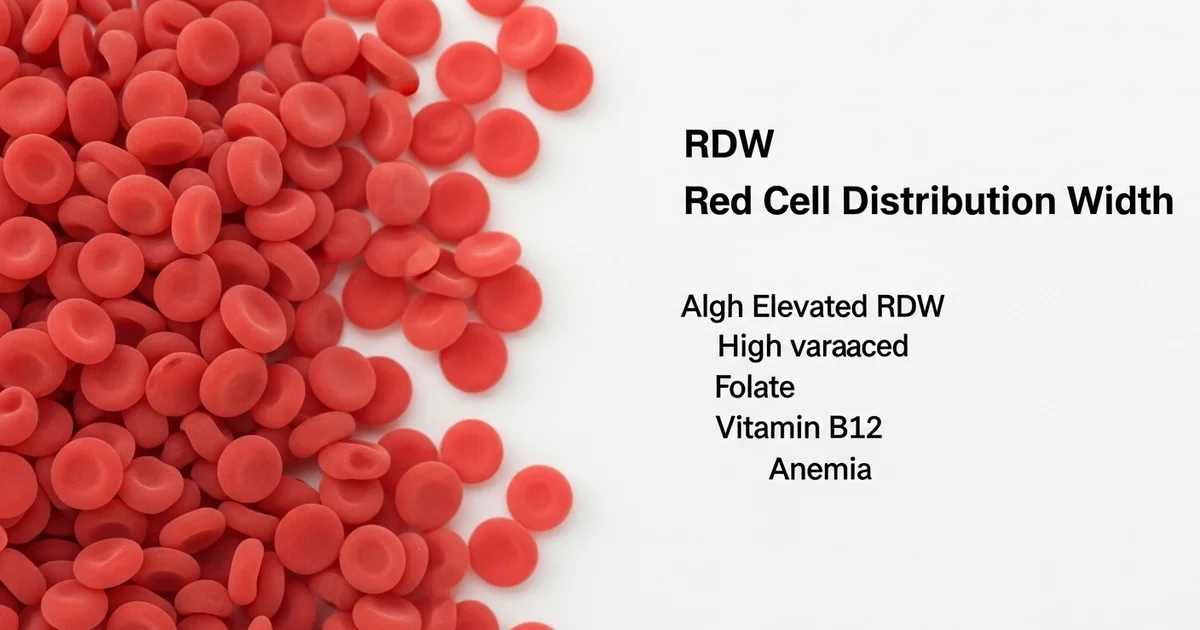
Direct answer: A high Red Cell Distribution Width (RDW) means there is a significant variation in the size of your red blood cells. It is often an early indicator of developing health issues, most commonly nutritional deficiencies like iron, folate, or vitamin B12 deficiency, which can lead to anemia. While not a standalone diagnostic tool, an elevated RDW prompts doctors to investigate underlying conditions, as it can also be associated with liver disease, inflammation, and other chronic illnesses.
TL;DR A high Red Cell Distribution Width (RDW) on your complete blood count (CBC) test indicates that your red blood cells vary more than usual in size. This measurement, known as anisocytosis, is often one of the earliest signs that your body is struggling to produce healthy, uniform red blood cells. While a high RDW itself isn't a diagnosis, it's a critical clue for your doctor, often pointing toward underlying nutritional deficiencies or other developing health problems long before other symptoms or lab values become abnormal.
- RDW measures the variation in red blood cell size, not the size itself. A high result means your cells are of unequal sizes.
- It is most commonly linked to nutritional deficiencies, particularly iron, vitamin B12, or folate deficiency, which are primary causes of anemia.
- A high RDW can appear before other classic signs of anemia, such as a low hemoglobin or hematocrit level, making it a valuable early warning.
- Beyond anemia, elevated RDW can be associated with chronic inflammation, liver disease, kidney disease, and certain inherited blood disorders.
- Your doctor will interpret your RDW result in the context of other CBC values, like the MCV (Mean Corpuscular Volume), to narrow down the potential cause.
- Treatment for a high RDW focuses on addressing the root cause, such as supplementing a diagnosed nutrient deficiency or managing an underlying chronic condition.
Want the full explanation? Keep reading ↓
Feeling Fatigued? High RDW Could Be an Early Clue
A high Red Cell Distribution Width (RDW) on your blood test results can be an early and sensitive indicator of underlying health issues, most notably nutritional deficiencies and developing anemia. While often overlooked, this simple marker provides crucial information about the health and uniformity of your red blood cells. Understanding what a high RDW means is the first step toward addressing the root cause and restoring your vitality.
The RDW is a measurement of the variation in the size of your red blood cells, a phenomenon known as anisocytosis. In a healthy state, your red blood cells are typically uniform in size and shape. A high RDW indicates that there is a significant variation, with both smaller and larger-than-normal red blood cells circulating in your bloodstream.
This size variability is often the first sign that something is amiss with red blood cell production in your bone marrow. It can appear even before other key markers, like hemoglobin, fall below the normal range, making it a valuable early warning signal for your doctor.
Seeing a High RDW on Your Report? Here's What It Means
Receiving a lab report with a flagged "high" RDW value can be confusing. Simply put, it means your red blood cells are not as uniform as they should be. Think of it like a factory producing components; if the quality control is good, all components are nearly identical. If there's a problem with the raw materials or machinery, you'll get a mix of different-sized components.
Your bone marrow is the factory for red blood cells. A high RDW suggests a problem in this production line, often stemming from a lack of essential "raw materials" like iron, vitamin B12, or folate. The [RDW blood test, a standard part of the complete blood count (CBC)], is therefore an essential tool for assessing red blood cell health.
This variation in size is clinically significant because it impairs the primary function of red blood cells: carrying oxygen. Cells that are too small, too large, or irregularly shaped are less efficient at transporting oxygen from your lungs to your tissues, which can lead to symptoms like fatigue, weakness, and shortness of breath.
Understanding the Numbers: RDW Reference Ranges
To understand if your RDW is high, you need to compare it to the established reference range. These ranges can vary slightly between laboratories and depend on the specific method used for measurement. Your lab report will typically show RDW as either a percentage (RDW-CV) or in femtoliters (RDW-SD).
While both measure the same phenomenon, they are calculated differently; you can learn more about the nuances in our guide that explains the [normal RDW range and SD vs. CV explained]. It is crucial to use the reference range provided by the lab that performed your test.
Below is a table of typical reference ranges for RDW.
| Parameter | Normal Range | Units | Notes |
|---|---|---|---|
| RDW-CV | 11.5 - 15.5 | % | Represents the coefficient of variation of red cell volume. Most common. |
| RDW-SD | 38 - 52 | fL | Represents the standard deviation of red cell volume. Less common. |
| Children (6mo - 2yr) | 11.5 - 14.5 | % | Ranges can vary significantly with age in early childhood. |
| Pregnancy | Up to 16.0 | % | RDW may slightly increase during pregnancy due to physiological changes. |
Important: An RDW value above the upper limit of the reference range is considered "high" or "elevated." For example, an RDW-CV of 16.5% would be considered high.
The Primary Suspect: Why High RDW Points to Anemia
A high RDW is most strongly associated with anemia, a condition where you lack enough healthy red blood cells to carry adequate oxygen to your body's tissues. In many cases, an elevated RDW is the earliest laboratory finding in developing anemias, particularly those caused by nutritional deficiencies.
This early detection is possible because the production of new, abnormally sized cells creates a mixed population in the bloodstream before the overall number of cells or hemoglobin level drops significantly. This makes RDW a highly sensitive marker for hematopoietic stress.
Iron Deficiency Anemia: The Most Common Culprit
Iron deficiency is the single most common cause of anemia worldwide, and a high RDW is its hallmark feature.
The process unfolds in stages. As your body's iron stores become depleted, the bone marrow lacks the necessary iron to produce normal-sized, hemoglobin-rich red blood cells. It begins to produce smaller, paler cells (microcytes). These new, small cells mix with the older, normal-sized cells still in circulation, creating a high degree of size variation and thus, a high RDW.
Common signs and symptoms of iron deficiency include:
- Persistent fatigue and lack of energy
- Pale skin, especially on the inner eyelids
- Shortness of breath with minimal exertion
- Headaches and dizziness
- Cold hands and feet
- Brittle nails or spoon-shaped nails (koilonychia)
- Cravings for non-food items like ice or dirt (pica)
Vitamin B12 and Folate Deficiency Anemia
Deficiencies in vitamin B12 (cobalamin) or vitamin B9 (folate) also cause a high RDW, but through a different mechanism.
These vitamins are essential for DNA synthesis, which is critical for cell division in the bone marrow. Without enough B12 or folate, cell division is impaired, leading to the production of abnormally large, immature red blood cells called macrocytes. This condition is known as megaloblastic anemia. The mix of these very large cells with any remaining normal-sized cells results in a high RDW.
Symptoms often overlap with iron deficiency but may also include distinct neurological signs:
- Fatigue and weakness
- Tingling or numbness in the hands and feet (peripheral neuropathy)
- Difficulty with balance and walking
- A smooth, sore, beefy-red tongue (glossitis)
- Cognitive difficulties, such as memory loss or "brain fog"
- Mouth ulcers
Using RDW with MCV: A Powerful Diagnostic Duo
A high RDW is a significant clue, but it becomes even more powerful when interpreted alongside the Mean Corpuscular Volume (MCV). The MCV measures the average size of your red blood cells. By combining these two markers, doctors can narrow down the potential causes of anemia with remarkable accuracy.
This combination helps differentiate between various types of anemia and other conditions. The table below outlines the classic interpretations.
| RDW | MCV | Common Potential Interpretations |
|---|---|---|
| High | Low | Iron Deficiency Anemia is the most likely cause. Other possibilities include thalassemia intermedia or red blood cell fragmentation. |
| High | Normal | Suggests a mixed picture. This can be seen in early-stage iron or B12/folate deficiency, mixed-deficiency anemia (e.g., both iron and folate deficiency), or certain hemoglobinopathies like sickle cell disease. |
| High | High | This combination strongly points to Vitamin B12 or Folate Deficiency. Other causes include autoimmune hemolytic anemia, significant liver disease, or certain chemotherapy treatments. |
| Normal | Low | Suggests a uniform population of small cells. This is classic for Anemia of Chronic Disease/Inflammation or heterozygous thalassemia. |
| Normal | Normal | A uniform population of normal-sized cells but not enough of them. This is seen in acute blood loss, kidney disease, or some cases of anemia of chronic disease. |
| Normal | High | Suggests a uniform population of large cells. This can be associated with aplastic anemia, myelodysplastic syndrome (MDS), or chronic liver disease. |
Not Just Anemia: Other Causes of a High RDW
While nutritional deficiencies are the most common cause, a high RDW can also signal other systemic health issues. It is increasingly recognized as a general marker of inflammation and physiological stress.
Conditions That Can Elevate RDW:
- Liver Disease: Chronic liver disease can affect red blood cell lipids and maturation, leading to size variations.
- Chronic Inflammation or Autoimmune Disease: Conditions like rheumatoid arthritis, lupus, or inflammatory bowel disease (IBD) can interfere with red blood cell production and survival, raising RDW.
- Kidney Disease: Impaired kidney function affects the production of erythropoietin (EPO), a hormone essential for red blood cell creation, which can lead to a higher RDW.
- Hemolytic Anemia: Conditions where red blood cells are destroyed prematurely (hemolysis) cause the bone marrow to ramp up production, releasing immature cells of different sizes and raising the RDW.
- Blood Transfusions: A recent transfusion introduces a donor's red blood cells, creating a mixed population of cells with different sizes and temporarily elevating the RDW.
- Myelodysplastic Syndrome (MDS): This group of bone marrow disorders is characterized by ineffective and disordered blood cell production, often resulting in a very high RDW.
Your Next Steps: What to Do About a High RDW
Finding a high RDW on your lab report is not a diagnosis in itself, but a call to action. It's a critical piece of data that warrants a conversation with your healthcare provider.
Consult Your Doctor: Do not ignore a high RDW. Schedule an appointment to discuss the results. Your doctor will interpret the RDW in the context of your entire CBC panel, your symptoms, and your medical history.
Prepare for Follow-Up Testing: Based on your RDW, MCV, and other findings, your doctor will likely order more specific tests to pinpoint the cause. This is a normal and necessary part of the diagnostic process.
Common Follow-Up Tests:
- Iron Panel: Includes serum iron, ferritin (iron stores), and transferrin saturation (TIBC/UIBC) to definitively diagnose or rule out iron deficiency.
- Vitamin B12 and Folate Levels: A simple blood test to check for deficiencies in these key vitamins.
- Reticulocyte Count: Measures the number of young red blood cells being produced by the bone marrow, indicating if the marrow is responding appropriately.
- Peripheral Blood Smear: A microscopic examination of your blood to visually assess the size, shape, and appearance of your red blood cells.
- Inflammatory Markers: Tests like C-reactive protein (CRP) or Erythrocyte Sedimentation Rate (ESR) may be ordered if chronic inflammation is suspected.
By systematically investigating the cause, your doctor can develop a targeted treatment plan to correct the underlying issue, normalize your RDW, and, most importantly, resolve your symptoms.
Frequently Asked Questions
What is the most common cause of abnormal Red Cell Distribution Width (RDW) levels?
The most common cause of a high RDW is iron deficiency anemia. As the body's iron stores are depleted, the bone marrow produces progressively smaller red blood cells. This mix of new, small cells and older, normal-sized cells creates significant size variation, elevating the RDW. This change is often one of the earliest signs of iron deficiency, appearing before hemoglobin levels drop. Other common causes include vitamin B12 and folate deficiency.
How often should I get my Red Cell Distribution Width (RDW) tested?
RDW is a standard part of the Complete Blood Count (CBC), which is one of the most commonly ordered blood tests. For a healthy individual with no symptoms, RDW is typically checked during a routine annual physical or wellness exam. If you have been diagnosed with a condition known to affect RDW (like anemia, liver disease, or an inflammatory disorder), your doctor may order a CBC more frequently—such as every 3 to 6 months—to monitor your condition and your response to treatment.
Can lifestyle changes improve my Red Cell Distribution Width (RDW) levels?
Yes, lifestyle changes can significantly improve RDW levels if the underlying cause is related to nutritional deficiencies. If your high RDW is due to iron, vitamin B12, or folate deficiency, incorporating foods rich in these nutrients can help.
- For Iron: Red meat, poultry, fish, lentils, beans, spinach, and fortified cereals.
- For Vitamin B12: Animal products like meat, fish, eggs, and dairy.
- For Folate: Leafy green vegetables, citrus fruits, beans, and fortified grains. In many cases, dietary changes alone may not be sufficient, and your doctor will recommend targeted supplementation to correct the deficiency more rapidly. Addressing the root cause is the only effective way to normalize your RDW.
Medical Disclaimer
This article is for educational purposes only. Always consult a healthcare professional.