Understanding Your RDW Blood Test Results
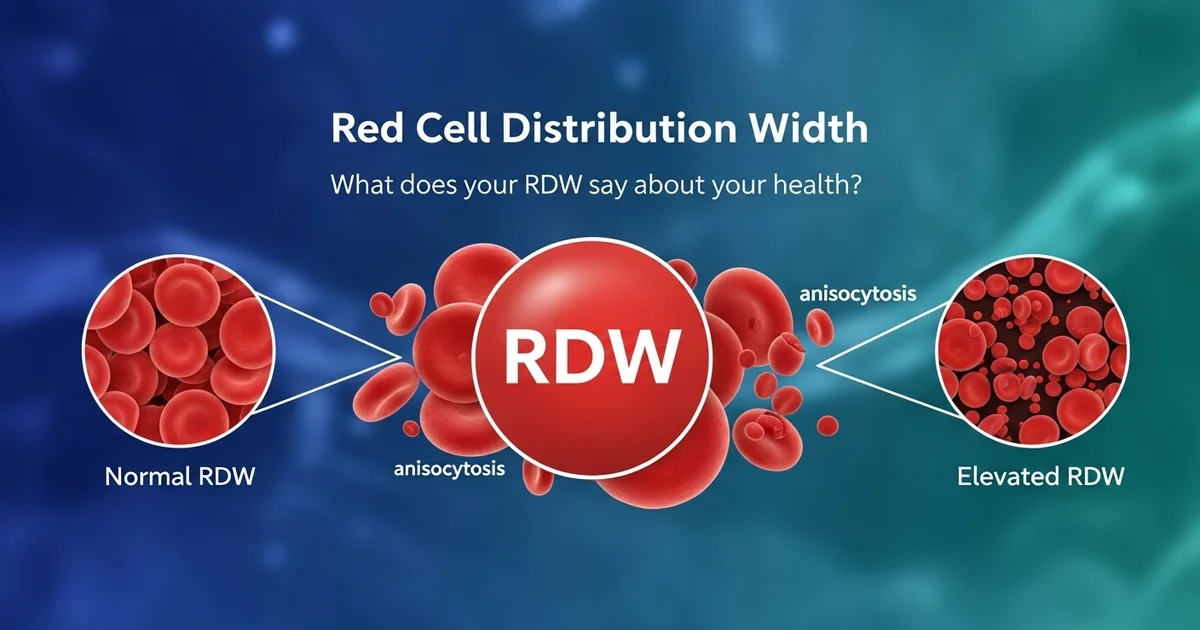
Direct answer: Red Cell Distribution Width (RDW) is a measurement on a complete blood count (CBC) that reflects the variation in red blood cell size. A normal RDW means your red blood cells are mostly uniform in size. An elevated RDW indicates significant variation in cell size (anisocytosis), which can be an early sign of conditions like iron deficiency anemia, vitamin B12 or folate deficiency, or other underlying health issues. It is interpreted alongside other CBC values for a complete picture.
TL;DR Red Cell Distribution Width, or RDW, is a standard part of a complete blood count (CBC) that measures the variability in the size of your red blood cells. While other tests like MCV measure the average size, RDW looks at the range from the smallest to the largest cells. A high RDW value, called anisocytosis, means there is a significant difference in their sizes, which can be an early clue for certain health problems, often appearing before other symptoms or lab values change.
- RDW is a measurement of the variation in red blood cell size, not the average size.
- A normal RDW range is typically 12% to 15%, but this can vary slightly between labs.
- A high RDW is the most common abnormality and indicates a mix of small and large red blood cells.
- Elevated RDW is often one of the earliest signs of nutritional deficiencies, such as iron, vitamin B12, or folate deficiency anemia.
- It can also be elevated in conditions like liver disease, thalassemia, or after a recent blood transfusion.
- A low RDW is rare and usually not clinically significant, indicating very uniform red blood cells.
- Your RDW result is always interpreted in context with other CBC values, like MCV (mean corpuscular volume) and hemoglobin, to help your doctor determine the underlying cause.
Want the full explanation? Keep reading ↓
Interpreting RDW Results in a CBC Panel
The Complete Blood Count (CBC) is one of the most frequently ordered lab tests, offering a comprehensive snapshot of your blood health. While many people focus on red and white blood cell counts, a lesser-known but critically important value is the Red Cell Distribution Width (RDW). Understanding your RDW is key to uncovering subtle clues about your health, often before other signs appear.
RDW measures the variation in the size of your red blood cells (erythrocytes). While it's normal for red blood cells to have some size variation, a high degree of variation—a condition known as anisocytosis—can be an early indicator of underlying medical issues. This article will guide you through interpreting your RDW results, explaining what they mean in the context of your overall CBC panel.
What Does Your RDW Result Actually Tell You?
Your RDW result provides a quantitative measure of the variability in red blood cell volume. Think of it this way: in a healthy state, your red blood cells are produced to be relatively uniform in size and shape. The RDW test quantifies how much they deviate from this uniformity.
A higher RDW percentage means there is a greater difference between the smallest and largest red blood cells in your sample. This is a crucial piece of information because many conditions affect the size of newly produced red blood cells. To get a foundational understanding of this parameter, it's helpful to learn about the [RDW blood test and how it measures RBC size variation] in more detail.
Important: RDW is almost never interpreted in isolation. Its true diagnostic power is unlocked when viewed alongside the Mean Corpuscular Volume (MCV), which measures the average size of your red blood cells. Together, these two markers help classify different types of anemia and other hematological disorders.
Is Your RDW Within the Normal Range?
Before interpreting an abnormal result, it's essential to know the standard reference ranges. These ranges can vary slightly between laboratories depending on the specific analyzer and population they serve. The RDW is typically reported in two ways: as a percentage (RDW-CV) or in femtoliters (RDW-SD).
The table below provides typical reference ranges for RDW-CV, which is the more commonly reported value. Always compare your results to the specific range provided on your lab report.
| Population | Normal Range (RDW-CV) | Units | Notes |
|---|---|---|---|
| Adults | ~12.0% to 15.5% | % | Varies slightly by lab and analytical method. |
| Newborns | 14.9% to 18.7% | % | Higher RDW is normal due to physiological changes. |
| Infants/Children | ~12.0% to 14.5% | % | Gradually decreases to adult levels throughout childhood. |
It's important to understand the difference between the two main types of RDW measurement. For a detailed breakdown, you can read about the [normal RDW range and the distinction between SD vs. CV] to better grasp your lab report. A result within the normal range is generally a good sign, indicating uniformity in your red blood cell population.
Have a High RDW? Here's What It Could Indicate
A high RDW is a common and clinically significant finding. It signals that your bone marrow is producing red blood cells that are unequal in size. This is often one of the earliest signs of a nutritional deficiency or an underlying type of anemia.
The most common reason for a high RDW is a problem with red blood cell production, often tied to the availability of key nutrients. In many cases, a [high RDW can be an early sign of anemia or deficiency], sometimes appearing even before your hemoglobin and hematocrit levels drop. The interpretation of a high RDW depends heavily on the accompanying MCV result.
High RDW with a Low MCV
This pattern—high variation with small average cell size—is a classic indicator of conditions where hemoglobin production is impaired.
- Iron Deficiency Anemia: This is the most common cause of a high RDW and low MCV. As iron stores are depleted, the bone marrow produces smaller, paler red blood cells (microcytes). The RDW increases because there is a mix of older, normal-sized cells and newer, smaller cells.
- Thalassemia Trait (Minor): While thalassemia also involves small red blood cells (low MCV), the RDW is often normal or only slightly elevated. This is a key feature that helps differentiate it from iron deficiency, as the genetic defect in thalassemia leads to the production of a uniformly small population of cells.
- Sideroblastic Anemia: A rarer condition where the body has iron but cannot incorporate it into hemoglobin, leading to a mix of normal and abnormal red blood cells.
High RDW with a Normal MCV
When the RDW is high but the average cell size is normal, it can suggest a few different scenarios.
- Early-Stage Nutritional Deficiency: This is a critical finding. It can represent the very beginning of iron, vitamin B12, or folate deficiency. The RDW increases before the average cell size (MCV) has had a chance to shift up or down.
- Mixed Anemia: This occurs when you have two different deficiencies at once, such as iron deficiency (which causes small cells) and folate deficiency (which causes large cells). The competing effects average out the MCV to the normal range, but the RDW becomes very high due to the wide variety of cell sizes.
- Chronic Liver Disease: Liver disease can affect red blood cell maturation and lifespan, leading to increased size variability.
- Myelodysplastic Syndrome (MDS): This bone marrow disorder can cause the production of abnormally shaped and sized cells, often resulting in a high RDW with a normal or high MCV.
High RDW with a High MCV
This combination—high variation with large average cell size (macrocytosis)—points toward issues with DNA synthesis during red blood cell production.
- Vitamin B12 Deficiency: A primary cause of macrocytic anemia. Lack of B12 impairs DNA synthesis, leading to the production of large, immature red blood cells (megaloblasts) and a high RDW.
- Folate (Vitamin B9) Deficiency: Similar to B12 deficiency, a lack of folate disrupts DNA synthesis and results in macrocytic anemia with a high RDW.
- Autoimmune Hemolytic Anemia: A condition where the immune system attacks and destroys red blood cells. The bone marrow responds by rapidly releasing large, immature red cells (reticulocytes), which increases both the MCV and RDW.
- Cold Agglutinin Disease: An autoimmune condition where antibodies cause red blood cells to clump together at cold temperatures. Lab analyzers may read these clumps as single large cells, falsely elevating the MCV and RDW.
High RDW Without Anemia
An elevated RDW is not just a marker for anemia; it is increasingly recognized as a general indicator of inflammation and physiological stress. A high RDW in a person who is not anemic has been linked to an increased risk of:
- Cardiovascular Events: Studies have shown that a high RDW is an independent predictor of adverse outcomes in patients with heart failure, coronary artery disease, and stroke.
- Inflammatory Conditions: Chronic inflammation from conditions like Inflammatory Bowel Disease (IBD) or rheumatoid arthritis can disrupt red blood cell production and lead to a higher RDW.
- Poor Prognosis in Critical Illness: In hospitalized patients, a rising RDW is often associated with a worse prognosis, regardless of the primary diagnosis.
- Increased All-Cause Mortality: Large population studies have found a strong correlation between a higher RDW and an increased risk of death from all causes, even in the general population.
Concerned About a Low RDW? Here's What It Might Mean
A low RDW result is rarely a cause for concern and is not typically considered clinically significant. It simply indicates that your red blood cells are very uniform in size, which is generally a healthy state. There is no medical condition directly associated with a low RDW.
However, a low or normal RDW in the presence of an abnormal MCV can provide clues. For example:
- Anemia of Chronic Disease: Can sometimes present with a low-normal RDW and a low MCV.
- Aplastic Anemia: May show a low-normal RDW with a high MCV, as the bone marrow is failing to produce new cells of any kind.
- Thalassemia: As mentioned, often presents with a very low MCV but a normal or low-normal RDW due to the uniform production of small cells.
In these cases, your doctor's focus will be on the abnormal MCV and other CBC parameters, not the low RDW itself.
How to Navigate Your RDW Results with Your Doctor
Receiving an abnormal lab result can be stressful, but it's important to approach it systematically. Your RDW is a single data point, and its meaning comes from its context within the full CBC panel and your overall health.
Step 1: Don't Panic An abnormal RDW is a clue, not a diagnosis. Many factors, including recent illness or mild nutritional shortfalls, can temporarily affect it.
Step 2: Look at the RDW and MCV Together This combination is the most powerful tool for initial interpretation. Use this table as a general guide to discuss with your healthcare provider.
| RDW Result | MCV Result | Common Clinical Considerations |
|---|---|---|
| High | Low | Iron Deficiency Anemia is the most likely cause. |
| High | Normal | Early nutritional deficiency (iron, B12, folate), mixed anemia, or chronic liver disease. |
| High | High | Vitamin B12 or Folate Deficiency, autoimmune hemolytic anemia. |
| Normal | Low | Anemia of chronic disease, Thalassemia trait. |
| Normal | High | Aplastic anemia, chronic liver disease, alcohol use, certain medications. |
Step 3: Discuss Your Symptoms and Health History Be prepared to talk to your doctor about any symptoms you're experiencing, even if they seem minor. Relevant symptoms include:
- Fatigue or weakness
- Shortness of breath
- Pale skin
- Dizziness or lightheadedness
- Cold hands and feet
- Unusual food cravings (pica)
- Numbness or tingling in hands or feet (a sign of B12 deficiency)
Your diet (e.g., vegan or vegetarian), family history of blood disorders, and any chronic medical conditions are also crucial pieces of information.
Step 4: Prepare for Potential Follow-Up Tests Based on your RDW, MCV, and symptoms, your doctor may order additional tests to confirm a diagnosis. These can include:
- Iron Panel: Measures ferritin, serum iron, TIBC, and transferrin saturation to diagnose iron deficiency.
- Vitamin B12 and Folate Levels: Direct measurement of these vitamins in your blood.
- Reticulocyte Count: Measures the number of young red blood cells to assess bone marrow function.
- Hemoglobin Electrophoresis: Used to diagnose hemoglobinopathies like thalassemia or sickle cell disease.
- Peripheral Blood Smear: A microscopic examination of your blood to visually assess the size, shape, and color of your blood cells.
By working with your provider and understanding how RDW fits into the larger picture, you can effectively use this powerful marker to monitor and improve your health.
Frequently Asked Questions
What is the most common cause of abnormal Red Cell Distribution Width (RDW) levels?
The most common cause of a high RDW is iron deficiency anemia. This condition leads to the production of progressively smaller red blood cells, creating a high degree of size variation between older, larger cells and newer, smaller ones. Other common causes include vitamin B12 and folate deficiency. A low RDW is not considered abnormal and has no clinical significance.
How often should I get my Red Cell Distribution Width (RDW) tested?
RDW is part of a standard Complete Blood Count (CBC) panel. For a healthy adult, a CBC is typically included in a routine physical exam, which may occur every 1 to 3 years. If you have a diagnosed condition like anemia, a chronic inflammatory disease, or heart disease, or if you are undergoing treatment that can affect your blood cells, your doctor may recommend more frequent testing (e.g., every 3 to 6 months) to monitor your condition and response to therapy.
Can lifestyle changes improve my Red Cell Distribution Width (RDW) levels?
Yes, if your high RDW is caused by a nutritional deficiency, lifestyle changes can be very effective. Addressing the underlying cause is key.
- For Iron Deficiency: Increase your intake of iron-rich foods like red meat, poultry, fish, lentils, spinach, and fortified cereals. Consuming vitamin C (e.g., from citrus fruits) with iron-rich meals can enhance absorption.
- For B12/Folate Deficiency: Increase your intake of foods rich in these vitamins. Folate is found in leafy green vegetables, beans, and fortified grains. Vitamin B12 is primarily found in animal products like meat, fish, eggs, and dairy. Vegans and some vegetarians may need B12 supplementation. Correcting the deficiency will allow your bone marrow to produce uniform, healthy red blood cells, which will gradually lower your RDW back to a normal range.
Medical Disclaimer
This article is for educational purposes only. Always consult a healthcare professional.