Feeling Concerned About Your RDW Results? We Can Help.
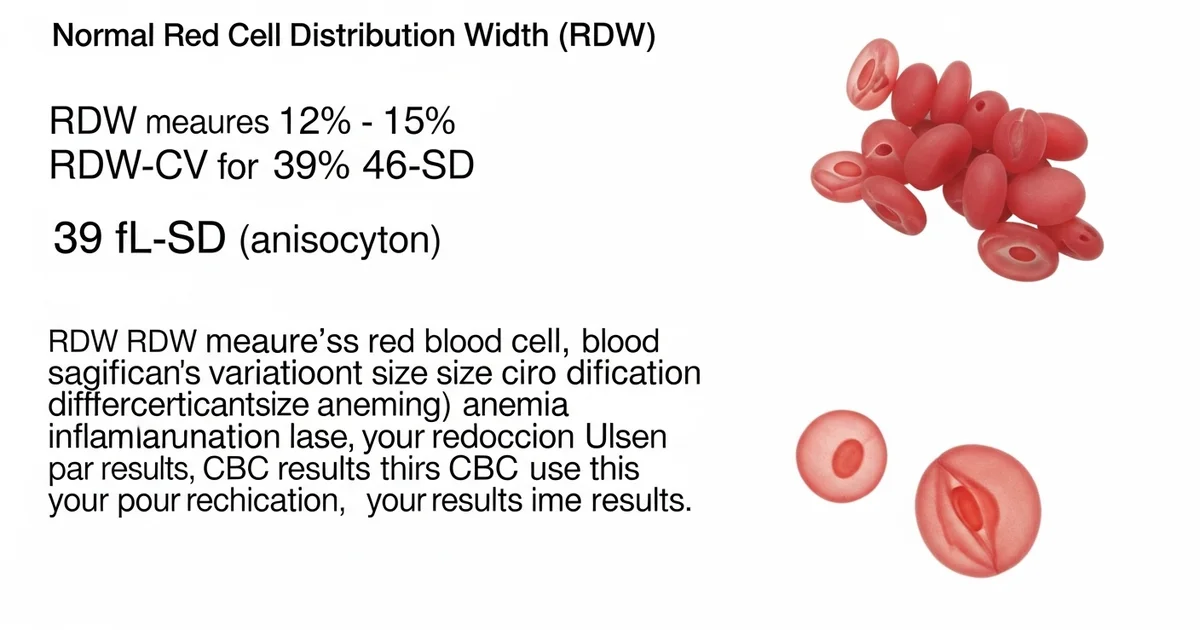
Direct answer: The normal Red Cell Distribution Width (RDW) range is typically 12% to 15% for RDW-CV and 39 to 46 fL for RDW-SD. RDW measures the variation in red blood cell size. A high RDW means there's a significant size difference, a condition called anisocytosis. This can indicate potential health issues like anemia or inflammation. Your doctor uses this value, along with other CBC results, to assess your overall health and guide further testing if needed.
TL;DR Red Cell Distribution Width (RDW) is a standard part of a complete blood count (CBC) that measures the variation in the size of your red blood cells. A low number indicates your red blood cells are mostly uniform in size, which is normal. A high RDW value, known as anisocytosis, means there is a significant variation in their size. This can be an early sign of certain health conditions, even before other symptoms appear.
- What is RDW? It's a blood test parameter that quantifies the variability (heterogeneity) in the size of your red blood cells (erythrocytes).
- Normal RDW Range: For RDW-CV (Coefficient of Variation), the normal range is typically 12% to 15%. For RDW-SD (Standard Deviation), it's usually 39 to 46 femtoliters (fL).
- RDW-CV vs. RDW-SD: RDW-CV is a percentage calculation of the size variation relative to the average cell size (MCV). RDW-SD is an absolute measurement in femtoliters of the width of the red blood cell size distribution curve.
- High RDW Meaning: A high RDW suggests a greater-than-normal variation in red blood cell size. It's often associated with conditions like iron deficiency anemia, vitamin B12 or folate deficiency, liver disease, or chronic inflammation.
- Low RDW Meaning: A low RDW is not typically a cause for concern and usually indicates that your red blood cells are very uniform in size.
- Clinical Significance: RDW is rarely looked at in isolation. Your doctor interprets it alongside other CBC values, like the Mean Corpuscular Volume (MCV), to help diagnose different types of anemia and other disorders.
Want the full explanation? Keep reading ↓
Confused by Your RDW Lab Results? A Guide to Normal Ranges
Red Cell Distribution Width (RDW) is a standard part of a Complete Blood Count (CBC) that provides crucial information about your red blood cells. While often overlooked, it is a powerful indicator of underlying health conditions, particularly different types of anemia. Understanding what your RDW value means, whether it's reported as RDW-CV or RDW-SD, is the first step toward deciphering your blood test results.
The RDW test measures the variation in the size of your red blood cells, a condition known as anisocytosis. A high RDW means there is a significant difference between your smallest and largest red blood cells. A low or normal RDW indicates your red blood cells are mostly uniform in size. For a deeper dive into the fundamentals, learning about the [RDW blood test and how it measures red blood cell size variation] can provide valuable context.
This article will break down the normal ranges for RDW, explain the critical difference between RDW-SD and RDW-CV, and explore what high or low levels might mean for your health.
What is a Normal RDW Range?
The normal range for Red Cell Distribution Width can vary slightly depending on the laboratory and the specific method used for measurement (RDW-CV vs. RDW-SD). It is crucial to compare your results to the reference range provided on your specific lab report. However, generally accepted ranges provide a good baseline for understanding your levels.
Below is a table outlining typical reference ranges for both RDW-CV (Coefficient of Variation) and RDW-SD (Standard Deviation).
| Parameter | Population | Normal Range | Units | Notes |
|---|---|---|---|---|
| RDW-CV | Adults | ~11.5 - 15.0 | % | This is the most commonly reported RDW value. |
| RDW-SD | Adults | ~39 - 46 | fL | Represents an absolute measurement in femtoliters. |
| RDW-CV | Newborns | ~14.9 - 18.7 | % | Physiologically higher at birth and decreases with age. |
| RDW-CV | Children | ~11.5 - 14.5 | % | Reaches adult levels after 6 months of age. |
Important: These ranges are for general guidance only. Always consult with your healthcare provider to interpret your individual lab results within the context of your overall health and the specific reference range from the testing laboratory.
RDW-SD vs. RDW-CV: Can't Make Sense of the Two Values?
One of the most confusing aspects of the RDW test is that it can be reported in two different ways: RDW-CV or RDW-SD. While both measure the same phenomenon—variation in red blood cell size—they calculate it differently, resulting in different numbers and units. Understanding the distinction is key to interpreting your results correctly.
RDW-CV (Coefficient of Variation)
The RDW-CV is the most common RDW value reported by labs. It is a calculated value that takes into account both the standard deviation of red blood cell volume and the Mean Corpuscular Volume (MCV), which is the average size of your red blood cells.
- Calculation: It's calculated with the formula: (Standard Deviation of RBC volume ÷ MCV) × 100.
- Unit: It is expressed as a percentage (%).
- What it means: Because the RDW-CV is dependent on the MCV, it represents the relative variation in cell size compared to the average size. If all cells are uniformly small (low MCV) or uniformly large (high MCV), the RDW-CV can remain within the normal range.
RDW-SD (Standard Deviation)
The RDW-SD is a less commonly reported value but provides a more direct measurement. It is an absolute measure of the variation in red blood cell size.
- Calculation: It is derived directly from the red blood cell histogram, measuring the width of the distribution curve at 20% of its height.
- Unit: It is expressed in femtoliters (fL).
- What it means: RDW-SD is a direct, absolute measurement of the size difference between the smallest and largest red blood cells. It is not influenced by the MCV (average cell size). This makes it particularly useful for detecting small populations of larger or smaller cells, even when the average cell size is normal.
Which is Better? A Simple Comparison
Think of it like this: imagine you have two groups of people.
- Group A: A class of 5th graders. Their heights are all very similar.
- Group B: A mix of 5th graders and professional basketball players. Their heights are wildly different.
RDW-SD is like measuring the actual height difference in inches between the shortest and tallest person in each group. The difference in Group B would be huge.
RDW-CV is like describing the height variation relative to the average height of the group.
The choice between RDW-CV and RDW-SD depends on the clinical context, but both provide valuable information about red blood cell uniformity.
| Feature | RDW-CV (Coefficient of Variation) | RDW-SD (Standard Deviation) |
|---|---|---|
| Measurement Type | Relative calculation | Direct, absolute measurement |
| Unit | Percentage (%) | Femtoliters (fL) |
| Influence of MCV | Yes, highly influenced by the average cell size. | No, independent of the average cell size. |
| Primary Use | General screening for anisocytosis. | More sensitive in detecting subtle size variations. |
Worried About a High RDW? Here's What It Means
A high RDW is the most clinically significant finding from this test. It indicates a high degree of variation in red blood cell size (anisocytosis) and is a red flag that prompts further investigation. A high RDW is rarely an isolated finding and is almost always interpreted alongside the MCV to narrow down potential causes.
A high RDW means your bone marrow is producing red blood cells that are unequal in size. This can happen when there's a problem with red blood cell production, often related to a nutrient deficiency, or when there is increased red blood cell destruction.
Common Causes of a High RDW
A high RDW is a hallmark of many types of anemia and other conditions.
- Iron Deficiency Anemia: This is the most common cause of a high RDW. In early iron deficiency, the body produces smaller red blood cells (low MCV), leading to a mix of normal-sized and small-sized cells, which dramatically increases the RDW.
- Vitamin B12 or Folate Deficiency: These deficiencies lead to megaloblastic anemia, where the production of red blood cells is impaired. The body releases abnormally large red blood cells (high MCV), which, when mixed with normal cells, results in a high RDW.
- Recent Blood Transfusion: A transfusion introduces a population of donor red blood cells, which will have a different average size than your own. This mixture of two distinct cell populations temporarily causes a very high RDW.
- Hemolytic Anemia: Conditions where red blood cells are destroyed prematurely (hemolysis) cause the bone marrow to ramp up production. It releases many immature red blood cells (reticulocytes), which are larger than mature ones, leading to a high RDW.
- Liver Disease: Chronic liver disease can affect red blood cell membrane lipids and maturation, leading to variations in cell size and a higher RDW.
High RDW as a Prognostic Marker
Beyond anemia, emerging research has shown that a high RDW can be an independent predictor of poor outcomes in a wide range of diseases.
- Cardiovascular Disease: Elevated RDW is associated with higher risks of heart attack, stroke, heart failure, and peripheral artery disease.
- Inflammatory Conditions: Chronic inflammation can disrupt red blood cell production and survival, leading to a higher RDW. This is seen in conditions like inflammatory bowel disease (IBD) and rheumatoid arthritis.
- Cancer: Some studies suggest a high RDW is linked to a more advanced stage and poorer prognosis in certain types of cancer.
- Overall Mortality: A persistently high RDW, even in individuals without a clear diagnosis, has been linked to a higher risk of all-cause mortality.
Is a Low RDW a Concern? Understanding the Implications
If your lab report shows a low RDW, you can generally be reassured. A low RDW value is not typically associated with any medical condition and is usually not considered clinically significant.
A low RDW simply means that your red blood cells are very uniform in size (homogenous). All the cells are nearly the same size, which indicates a very consistent and stable process of red blood cell production.
While a low RDW on its own is not a problem, it can sometimes be seen in the context of certain anemias where the cells are uniformly small or uniformly large. For example, in some cases of anemia of chronic disease or thalassemia trait, the cells might be consistently small (low MCV), leading to a normal or even low RDW.
How RDW and MCV Work Together for Diagnosis
RDW is most powerful when interpreted alongside the Mean Corpuscular Volume (MCV). This combination helps clinicians create a differential diagnosis for various types of anemia. The relationship between these two values is a cornerstone of hematology diagnostics.
Here's a simplified guide to how these values are often interpreted together:
| RDW | MCV | Potential Conditions |
|---|---|---|
| High | Low (Microcytic) | Iron Deficiency Anemia, Thalassemia Intermedia |
| High | Normal (Normocytic) | Early Iron/B12/Folate Deficiency, Mixed Anemia, Hemolytic Anemia, Liver Disease |
| High | High (Macrocytic) | Vitamin B12 Deficiency, Folate Deficiency, Autoimmune Hemolytic Anemia, Cold Agglutinin Disease |
| Normal | Low (Microcytic) | Anemia of Chronic Disease, Thalassemia Trait, Lead Poisoning |
| Normal | Normal (Normocytic) | Anemia of Chronic Disease, Kidney Disease, Acute Blood Loss |
| Normal | High (Macrocytic) | Aplastic Anemia, Chronic Liver Disease, Alcoholism, Myelodysplastic Syndrome (MDS) |
This table illustrates why a complete blood count is so important. A standalone RDW or MCV value provides limited information, but together, they offer a much clearer picture. The [RDW blood test is a key component] of this diagnostic puzzle, offering unique insights into the dynamic state of red blood cell production.
What to Do About an Abnormal RDW Result
An abnormal RDW is not a diagnosis in itself but a clue that something else is going on. The appropriate next steps depend entirely on the RDW value (high or normal) and the results of other tests, especially the MCV, hemoglobin, and hematocrit.
If Your RDW is High
- Don't Panic: A high RDW is a common finding. It's an indicator that requires further context.
- Consult Your Doctor: Your healthcare provider is the only person who can interpret your results correctly. They will look at your entire CBC panel, your medical history, and your symptoms.
- Expect Further Testing: Based on your results, your doctor may order additional tests to pinpoint the cause. These might include:
- Iron Panel: Ferritin, serum iron, TIBC to check for iron deficiency.
- Vitamin Levels: Serum vitamin B12 and folate levels.
- Reticulocyte Count: To check how well your bone marrow is producing new red blood cells.
- Peripheral Blood Smear: A microscopic examination of your blood to visually assess the size, shape, and appearance of your blood cells.
- Liver Function Tests: To assess liver health.
If Your RDW is Low or Normal
If your RDW is low or normal and your other CBC parameters (like hemoglobin and MCV) are also normal, no further action is typically needed. If your RDW is normal but other values are abnormal, your doctor will use that information to guide their diagnosis, as outlined in the RDW/MCV table above.
Frequently Asked Questions
What is the most common cause of abnormal Red Cell Distribution Width (RDW) levels?
The most common cause of an abnormally high RDW is iron deficiency anemia. In this condition, the bone marrow lacks the iron needed to produce healthy red blood cells. It begins to produce smaller, paler cells (microcytes). The mix of these new, small cells with existing normal-sized cells causes the variation in size to increase, leading to a high RDW. Other common causes include vitamin B12 and folate deficiency. An abnormally low RDW is not considered clinically significant.
How often should I get my Red Cell Distribution Width (RDW) tested?
RDW is part of the Complete Blood Count (CBC), which is one of the most frequently ordered blood tests. You may have your RDW tested:
- During routine health check-ups: Many doctors include a CBC as part of an annual physical.
- When investigating symptoms: If you have symptoms of anemia, such as fatigue, weakness, pale skin, or shortness of breath, a CBC including RDW will be ordered.
- To monitor a known condition: If you have been diagnosed with a type of anemia, liver disease, or an inflammatory condition, your doctor may order regular CBCs to monitor your RDW and other blood parameters to track disease activity and response to treatment.
Can lifestyle changes improve my Red Cell Distribution Width (RDW) levels?
Yes, lifestyle changes can improve a high RDW, but only if the underlying cause is related to diet. If a high RDW is caused by a nutritional deficiency, addressing that deficiency is the primary way to normalize it.
- For Iron Deficiency: Increasing your intake of iron-rich foods like red meat, poultry, fish, beans, lentils, and fortified cereals can help. Your doctor will likely recommend an iron supplement as well.
- For B12/Folate Deficiency: Increasing your intake of foods rich in these vitamins can help. Folate is found in leafy green vegetables, fruits, and beans. Vitamin B12 is found primarily in animal products like meat, fish, eggs, and dairy. If your high RDW is caused by a non-nutritional issue, such as a genetic disorder, chronic disease, or medication side effect, dietary changes will not correct the RDW value. Treatment must be directed at the underlying medical condition.
Medical Disclaimer
This article is for educational purposes only. Always consult a healthcare professional.